
Chama Management in Kenya: Digital Tools Are Changing the Way Chamas Operate
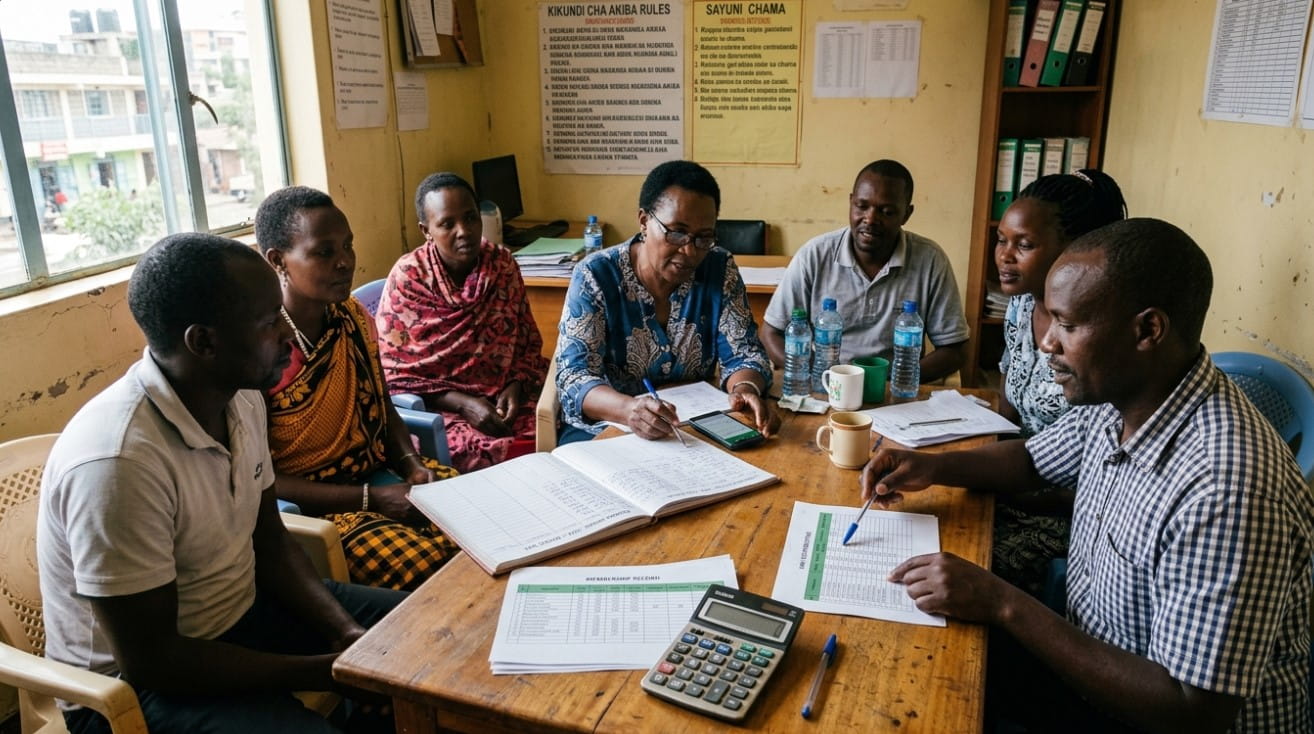
For years, Kenyan chamas have relied on notebooks, spreadsheets, M-Pesa messages and WhatsApp groups to manage their money.
That can work when a group is small.
As the chama grows, things get harder. Contributions increase. Members take loans. Guarantors get involved. Welfare funds need tracking. Fines have to be recorded. The treasurer has to reconcile payments, while members want to know exactly where their money stands.
This is where digital chama management is starting to change how savings groups operate.
The goal isn't to replace the way chamas work. It's to give members and officials better tools for managing the money, records and decisions that already exist.
For Kenyan groups looking to move from manual records to a chama management system, understanding what these tools can do is a good place to start.
1. What Is Chama Management?
Chama management refers to the processes a group uses to organise its members, contributions, savings, loans, welfare activities, investments, meetings and financial records.
The exact activities depend on the type of chama.
A savings group may focus mainly on regular contributions.
A table banking group may collect savings and use the pooled funds to issue loans to members.
A merry-go-round group may collect a fixed amount and rotate the payout among members.
A welfare group may focus on financial support during emergencies.
Some groups combine several of these activities.
Good management gives each activity clear rules and reliable records.
1a. What Does a Chama Manager or Committee Actually Manage?
Chama management can involve much more than collecting monthly contributions.
A committee may need to manage:
Member registration.
Contributions.
Savings.
Loans.
Loan repayments.
Guarantors.
Welfare funds.
Fines and penalties.
Expenses.
Investments.
Meetings.
Financial reports.
Member statements.
Group decisions.
As the number of transactions increases, keeping all of this in one notebook becomes difficult.
The challenge becomes even greater when different officials need access to different information.
2. How Chamas Have Traditionally Managed Their Finances
Most Kenyan chamas didn't start with specialised software.
They started with simple tools that were available and familiar.
A typical group might use:
A physical cashbook.
Exercise books.
Excel spreadsheets.
Bank statements.
M-Pesa messages.
Printed receipts.
WhatsApp groups.
Meeting minutes.
These tools can still have a place.
The problem starts when the group becomes dependent on several disconnected records.
One contribution may appear in an M-Pesa message, another in a notebook and another in an Excel sheet.
The treasurer then has to make sure all three records agree.
That creates room for mistakes.
2a. The Problem With Scattered Chama Records
Imagine a chama with 30 members.
Every month, 30 contributions need to be recorded.
Then add loan repayments, welfare contributions, fines and expenses.
After one year, the group could have hundreds or thousands of individual transactions.
Finding one member's contribution history can take time.
Finding the balance of an outstanding loan can take even longer.
And when records don't match, someone has to investigate.
The larger the group becomes, the more important a centralised record becomes.
3. Why Chama Management Is Becoming More Digital
Kenya already has a strong digital financial ecosystem.
Mobile money has changed how people send and receive money. Digital banking has changed how people access financial services. Smartphones have made it easier for groups to communicate and access information.
Chamas are increasingly able to bring some of those same conveniences into their own financial management.
Instead of recording a transaction in one place and updating another record later, a digital system can bring activities together.
A member's contribution can sit alongside their savings history, loan balance and other relevant financial information.
That creates a clearer picture of the member and the group.
3a. Digital Chama Management Is More Than an App
A chama app can sound simple.
But useful chama management software should handle the underlying financial workflows too.
For example, if a member makes a contribution, the system should be able to record:
The member.
Amount.
Date.
Contribution type.
Payment reference where applicable.
Resulting balance.
If that member has a loan, the system should keep the loan information separate but connected to the member.
The same principle applies to welfare, fines and other financial activities.
The value comes from connecting the records.
4. What Should a Digital Chama Management System Handle?
A useful chama management system in Kenya should cover the core activities of the group.
4a. Member Management
The system should provide a central place for member information.
It should also support different member roles.
For example, the chairperson, treasurer and secretary may need different permissions from ordinary members.
4b. Contribution and Savings Management
The system should make it possible to record regular contributions and track individual balances.
This is particularly useful when members contribute different amounts or when the group operates several funds.
4c. Loan Management
A digital system should support the complete loan lifecycle.
That can include:
Applications.
Eligibility checks.
Approvals.
Guarantors.
Disbursement.
Interest.
Repayments.
Outstanding balances.
Overdue loans.
4d. Welfare Management
Welfare contributions should be distinguishable from ordinary savings.
The group should be able to track contributions, assistance and remaining balances without mixing welfare money into other financial records.
4e. Fines and Penalties
A system can record penalties consistently according to the group's rules.
This is useful for late contributions, missed meetings and other agreed penalties.
4f. Financial Reporting
Officials should be able to generate useful reports without rebuilding the numbers manually every month.
Members may also need access to their own financial statements.
4g. Notifications
Automated reminders can help members keep track of:
Contribution deadlines.
Loan repayments.
Meetings.
Other group activities.
That reduces the amount of manual follow-up required from officials.
5. How Digital Tools Can Improve Chama Record Keeping
Record keeping is one of the strongest reasons to consider digital management.
A paper record can tell you what someone wrote down.
A properly structured digital record can connect that transaction to the member, financial activity and resulting balance.
This makes information easier to search and analyse.
For example, a treasurer shouldn't have to go through twelve months of pages to determine how much a member has contributed.
The system should be able to provide that information directly.
5a. Member Statements
Members often want to know:
How much have I contributed?
How much have I saved?
How much do I owe?
How much have I repaid?
Which loans have I guaranteed?
What penalties do I have?
What is my current balance?
Digital systems can make these records easier to access.
That improves transparency without requiring the treasurer to prepare every statement manually.
5b. Financial History
A member's financial history should tell a consistent story.
For example:
January: KSh 5,000 contribution
February: KSh 5,000 contribution
March: KSh 5,000 contribution
April: KSh 20,000 loan
May: KSh 4,000 repayment
When records are structured this way, both members and officials can understand what has happened.
6. Digital Tools Can Make Chama Loan Management Easier
Loans are often among the most complicated activities in a chama.
The group has to know how much money is available, who qualifies, how much a member can borrow, who guarantees the loan and whether repayments are being made on time.
A spreadsheet can handle this.
But as the number of loans grows, managing the relationships between borrowers, guarantors and repayments becomes harder.
A dedicated system can connect these records.
6a. Loan Applications
Members can submit loan requests through a defined process.
Officials can then review the request against the group's rules.
This creates a clearer record than relying on meeting discussions alone.
6b. Guarantor Tracking
A guarantor's responsibility should be visible.
If a member guarantees several loans, the group should know about those commitments before approving another guarantee.
Digital records can make this easier to monitor.
6c. Repayment Tracking
Every repayment should reduce the correct outstanding balance.
The group should be able to identify overdue loans without manually checking every loan record.
This gives the committee a better view of the group's lending position.
7. M-Pesa and Digital Chama Management
M-Pesa is already part of everyday financial activity in Kenya.
Chamas can use mobile money to collect contributions and receive loan repayments.
But receiving money digitally doesn't automatically mean the group's records are digital.
Someone still has to match payments to members and financial categories.
A good digital system can help bridge that gap.
7a. The Difference Between Receiving Money and Recording Money
Suppose a member sends KSh 5,000 through M-Pesa.
The transaction confirms that money was sent.
The chama's records still need to establish what the KSh 5,000 represents.
Was it:
Savings?
Welfare?
Loan repayment?
A fine?
A special contribution?
That classification matters.
Digital chama management should connect the payment to the correct financial activity.
8. Digital Chama Management Can Improve Transparency
Trust is one of the foundations of any savings group.
Members are more comfortable when they can see how their money is being managed.
Transparency doesn't mean every member should have permission to change financial records.
It means members should be able to access appropriate information.
For example, a member may need to see their contribution history and loan balance.
The treasurer may need access to financial reports.
The chairperson may need oversight of approvals.
The system administrator may manage technical settings.
Different responsibilities can require different levels of access.
8a. Role-Based Access
Role-based permissions help separate responsibilities.
For example:
Chairperson: oversight and approvals.
Treasurer: financial management and reporting.
Secretary: member and meeting administration.
Member: personal financial information and relevant group updates.
The exact permissions should follow the group's governance structure.
This is one reason dedicated software can be more useful than sharing one Excel file among everyone.
9. Blockchain Adds Another Layer to Digital Chama Management
Blockchain is becoming relevant to chama management because it can provide a verifiable record of transactions.
This doesn't mean a chama needs cryptocurrency.
The two concepts are different.
A blockchain can be used as infrastructure for recording and verifying information without requiring members to buy or trade digital currencies.
For chama management, the interesting application is the transaction record.
If financial activity is recorded in a way that makes unauthorised changes difficult, the group gains another layer of accountability.
9a. What Blockchain Can Do for a Chama
Blockchain-backed systems can potentially help with:
Transaction verification.
Record integrity.
Audit trails.
Transparency.
Automated financial rules.
But blockchain doesn't fix poor governance.
If the group has unclear rules, blockchain can't decide what those rules should be.
Technology works best when it supports a sound management structure.
10. ChamaConnect: Bringing These Tools Together
This is where ChamaConnect, a MUIAA product, fits into the picture.
ChamaConnect is a digital financial management platform built for savings groups and other collective financial organisations.
The platform is designed to support different group structures, including table banking groups, SACCOs, welfare groups and merry-go-round groups.
Instead of forcing every group into one model, ChamaConnect is built around the different ways these groups manage money.
10a. Managing Members
ChamaConnect provides a central system for member management.
This gives officials a structured way to manage group membership and member-related information.
It also supports different roles and permissions, helping groups control who can access or manage particular activities.
10b. Managing Contributions and Savings
Members can have their financial activity recorded within the platform.
This gives the group a clearer view of contributions and savings than relying on scattered records.
For a chama with regular monthly contributions, that can make it easier to identify who has paid, who hasn't and how much each member has accumulated.
10c. Managing Loans and Guarantors
ChamaConnect brings loan applications, approvals, guarantors and repayments into a connected workflow.
This matters because a loan isn't simply a single transaction.
It's a relationship between the borrower, the group, the guarantors and the repayment schedule.
Keeping those records connected makes the loan easier to monitor.
10d. Managing Welfare
For groups with welfare activities, ChamaConnect provides tools for managing welfare contributions and assistance.
That allows welfare activity to remain distinct from ordinary savings and lending.
10e. Managing Merry-Go-Round Groups
Merry-go-round groups have a different operating model.
Members contribute regularly and take turns receiving the pooled amount.
The group needs to know who has contributed, whose turn is coming and whether the rotation is being followed.
Digital tracking can make that process easier to manage.
10f. Financial Reports
Financial reports give officials and members a clearer view of the group's activities.
Instead of manually compiling information from several records, digital systems can generate reports from the transactions already recorded.
This can save time for treasurers and make financial discussions more productive.
10g. Blockchain-Backed Records
ChamaConnect also uses blockchain technology as part of its approach to transaction integrity and transparency.
The purpose is practical.
The technology supports a more verifiable record of financial activity.
Members still operate within the rules of their chama. The blockchain sits underneath the system as part of the record-keeping infrastructure.
11. Digital Chama Management Doesn't Remove Human Responsibility
Technology can automate calculations and organise information.
It can't replace leadership.
A chama still needs people who can:
Make sound financial decisions.
Approve loans responsibly.
Follow group rules.
Resolve disagreements.
Protect member information.
Review financial reports.
Hold officials accountable.
The software should support those responsibilities.
It shouldn't become an excuse to stop reviewing the group's finances.
12. How to Choose Chama Software in Kenya
There are several things a group should examine before choosing a chama app or chama management software.
12a. Does It Support Your Type of Chama?
A merry-go-round doesn't operate exactly like a table banking group.
A welfare group doesn't operate exactly like an investment-focused chama.
Choose software that matches the group's actual structure.
12b. Can It Handle Contributions and Loans?
These are core functions for many savings groups.
Check how the system handles contribution schedules, loan applications, interest, guarantors and repayments.
12c. Does It Support M-Pesa?
For Kenyan groups, mobile-money compatibility can be particularly useful.
Check exactly how payments are received, recorded and reconciled.
12d. Can Members See Their Information?
Member visibility can reduce unnecessary questions and improve trust.
Look for personal statements, balances and transaction histories.
12e. Are There Different User Permissions?
The treasurer shouldn't necessarily have the same access as an ordinary member.
Check whether roles and permissions can be configured.
12f. Can You Generate Financial Reports?
A system should make reporting easier, not create another reporting job.
12g. How Are Records Protected?
Ask how the platform protects member and financial information.
Also ask whether it maintains an audit trail for important transactions.
12h. Is It Easy Enough for Members to Use?
A technically powerful system won't help much if members struggle to use it.
The best platform should make common tasks straightforward.
13. When Should a Chama Move to Digital Management?
There isn't one fixed membership number that determines when a group should adopt software.
A chama should consider the move when its current process starts creating unnecessary work or confusion.
Signs include:
The treasurer spends hours updating records.
Members frequently ask for contribution statements.
Loan balances are difficult to calculate.
Guarantor commitments aren't easy to track.
M-Pesa reconciliation takes too long.
Financial reports are prepared manually.
Records are stored in several places.
Members don't have enough visibility.
The group has multiple funds.
Financial transactions are increasing.
You don't have to wait until the records become unmanageable.
Moving earlier can make it easier to establish good digital habits.
14. The Future of Chama Management in Kenya
Kenyan chamas aren't going away.
If anything, the need for organised savings and investment groups remains strong.
What is changing is how these groups can manage themselves.
A chama can still meet around a table.
Members can still contribute every month.
They can still make decisions together.
The difference is that the records behind those activities can now be digital, searchable and easier to monitor.
As digital financial tools become more accessible, chama management is likely to become less dependent on one treasurer's notebook and more dependent on shared systems and clear controls.
That shift can improve both efficiency and accountability.
15. Frequently Asked Questions About Digital Chama Management
15a. What is digital chama management?
Digital chama management means using software or digital tools to manage activities such as members, contributions, savings, loans, welfare, payments and financial reports.
15b. What is chama management software?
Chama management software is a system designed to help savings groups manage their members and financial activities in one structured environment.
15c. What is the best chama management software in Kenya?
The right software depends on the group's structure and needs. Groups should compare contribution tracking, loans, guarantors, welfare, M-Pesa support, reporting, permissions, security and ease of use before choosing a platform.
15d. Can a chama use M-Pesa?
Yes. Many Kenyan chamas already use M-Pesa for contributions and other payments. The important part is making sure those payments are properly reconciled with the group's financial records.
15e. Can blockchain be used to manage a chama?
Yes. Blockchain can support transaction verification and record integrity. It can be used as underlying infrastructure without turning the chama into a cryptocurrency group.
15f. What is ChamaConnect?
ChamaConnect is a digital financial management platform developed by MUIAA for savings groups and other collective financial organisations.
15g. What types of groups can use ChamaConnect?
ChamaConnect is designed to support table banking groups, SACCOs, welfare groups and merry-go-round groups.
15h. Can ChamaConnect manage loans?
Yes. The platform supports loan management, including applications, approvals, guarantors and repayments.
15i. Can ChamaConnect manage welfare contributions?
Yes. The platform includes functionality for managing welfare contributions and assistance separately from other group financial activities.
15j. Does ChamaConnect use blockchain?
Yes. Blockchain technology forms part of ChamaConnect's approach to transaction integrity and transparency.
15k. Does blockchain mean members need cryptocurrency?
No. Blockchain is a technology for recording and verifying information. It doesn't require a chama to use cryptocurrency.
15l. Is digital chama management better than Excel?
It depends on the group's needs. Excel can work well for smaller groups with simple financial activities. Dedicated software becomes more useful as the number of members, transactions, loans and financial activities increases.
Conclusion
Chama management has always depended on trust and good records.
The tools are changing.
A notebook can record a contribution. A spreadsheet can calculate a balance. M-Pesa can move the money.
A dedicated digital system can bring those activities together.
For growing Kenyan chamas, that can mean easier contribution tracking, better loan management, clearer financial reports, stronger member visibility and less administrative work.
MUIAA is building ChamaConnect around this shift.
The platform combines everyday chama management tools with blockchain-backed infrastructure to give savings groups a more structured way to manage their financial activities.
The idea is simple: let chamas keep doing what they do best, while giving them better tools to manage the money and records behind it.
As ChamaConnect develops, the aim is to make digital financial management accessible to the groups that form such an important part of Kenya's savings and investment culture.